State Fair Bag Policy 2026 | Clear Bag Rules & Size Limits Explained
Heading to a state fair for the rides, the food, or an evening grandstand concert? Unlike a single stadium with one consistent rule, state fairs typically run a dual-rule system — general fairground bag rules can be more relaxed, while grandstand or main-stage concert areas often require strict clear bags. Here’s exactly what to expect under the typical state fair bag policy, with real examples from major fairs.
Quick Answer: State Fair Bag Policy at a Glance
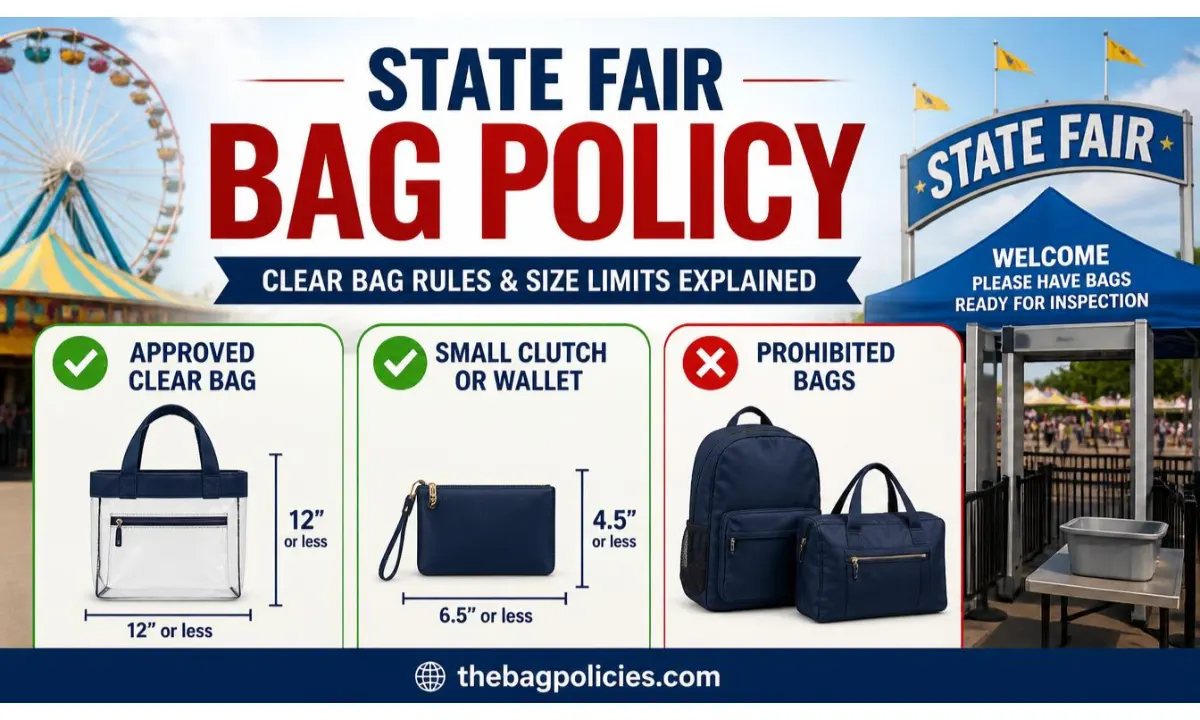
Most major state fairs allow standard bags on the general fairgrounds after a manual search, but almost all grandstand concerts enforce a strict clear bag policy. The safest choice across the board is a clear tote no larger than 12″ x 6″ x 12″, paired with a small non-clear clutch under 4.5″ x 6.5″ for privacy items.
| Question / Feature | Policy Rule |
|---|---|
| Clear bag required? | Highly recommended fairgrounds-wide; required at most grandstand/concert gates |
| Standard clear bag size | 12″ x 6″ x 12″ |
| Small clutch allowed? | Yes, up to 4.5″ x 6.5″ if non-clear |
| Backpacks allowed? | Prohibited unless clear and within size limits (especially at concert gates) |
| Medical/ADA bags | Allowed, subject to thorough inspection |
| Diaper/family bags | Allowed if a child is present |
| Storage lockers? | Rare; most fairs have none, a few offer limited paid smart lockers |
| Best safe choice | A 12″ x 6″ x 12″ clear tote plus a small non-clear privacy pouch |
| Last verified | September 2026 (individual state fair guest services pages) |
Official Policy Verification & Source Check
Official policy source: Individual state fair guest services and safety pages (examples: Wisconsin State Fair’s official policy page, cross-checked against WTMJ’s local news coverage)
Source type: Official fair organizers, corroborated by local news reporting
Last checked: September 2026
Confidence level: Medium-High (varies significantly by fair — see notes)
Important notes: There is no single nationwide “state fair bag policy” — each fair sets its own rules, and they can differ sharply. Wisconsin’s official 2026 policy caps all bags (including clear ones) at 9″ x 10″ x 12″, which is smaller and more restrictive than the 12″ x 6″ x 12″ clear-bag standard common at fairs that follow a stadium-style grandstand policy. Because of this fair-by-fair variation, this article presents the common patterns across major fairs rather than a single universal number — always confirm your specific fair’s current policy before you go.
How We Check This Policy: We prioritize each fair’s own official guest services or safety page over general recap guides, and we call out where a specific fair’s rule diverges from the common pattern — like Wisconsin’s all-bag 9″ x 10″ x 12″ cap — rather than smoothing over the differences.
What Makes State Fair Bag Policies Different
Unlike a single-venue stadium such as Ford Field, which applies one uniform clear bag rule fairgrounds-wide, state fairs are multi-zone environments covering hundreds of acres — livestock barns, exhibition halls, midways, and a ticketed grandstand or main stage all under one event. That creates the dual-rule pattern: a bag that’s fine for browsing the exhibition halls may get turned away at the grandstand gate if it isn’t clear. Fairs that skip the dual-rule setup entirely, like Wisconsin’s, instead cap every bag type at one flat dimension (9″ x 10″ x 12″) regardless of whether it’s clear or opaque — simpler to remember, but noticeably smaller than the 12″ x 6″ x 12″ clear-bag standard used elsewhere.
Allowed Bags and Size Limits Under Typical State Fair Bag Policies
| Bag Type | Entry Status | Max Dimensions | Conditions & Requirements |
|---|---|---|---|
| Clear Plastic/Vinyl/PVC Tote | Allowed | 12″ x 6″ x 12″ (common standard) | Required at most grandstand/concert gates |
| Clear Backpacks/Fanny Packs | Allowed | Within 12″ x 6″ x 12″ | Minimal pockets recommended |
| Small Non-Clear Clutch | Allowed | 4.5″ x 6.5″ | Fits inside a clear tote for convenience |
| All-Bag Flat Limit (e.g. Wisconsin) | Allowed | 9″ x 10″ x 12″ | Applies to clear and opaque bags alike |
| Empty Soft-Sided Bags | Allowed | Any size | Common exception even where size caps apply |
| Diaper Bags | Conditional | Standard size limit | Child must be present; manual search expected |
| Medical/ADA Bags | Conditional | N/A | Manually inspected, sometimes tagged by a supervisor |
| Non-Clear Backpacks/Large Purses | Prohibited | Exceeding small clutch limit | Especially strict at concert/grandstand checkpoints |
Clear Bags
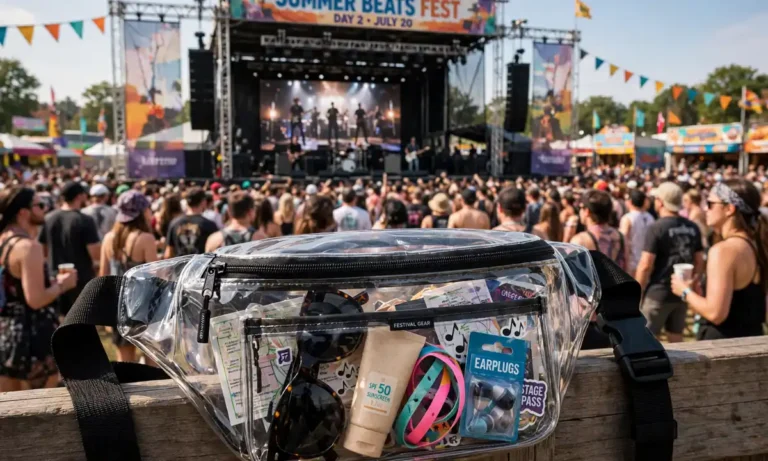
A 12″ x 6″ x 12″ clear tote is the most broadly accepted option across major fairs and is often the only bag guaranteed to work at both general admission and grandstand gates.
Small Clutches and Wallets
A non-clear clutch around 4.5″ x 6.5″ is commonly allowed as a privacy option and can usually be placed inside your clear tote.
Diaper and Medical Bags
Standard diaper bag rules apply at most fairs — permitted with a child present, typically subject to a more thorough manual search than a simple clear-bag “tap and look.” Medical equipment like insulin, oxygen, or breast pumps is generally allowed after inspection, sometimes with a supervisor tagging the bag as cleared.
Food and Beverage Rules
Most fairs allow small personal snacks and one factory-sealed water bottle per person, plus empty reusable bottles for refilling on-site. Hard-sided coolers and outside alcohol are almost universally banned; some fairs permit a soft-sided cooler strictly for medication or baby formula.
Prohibited Items Under Typical State Fair Bag Policies
- Oversized non-clear bags: large backpacks, luggage, duffel bags, and briefcases
- Hard-sided coolers: soft-sided versions sometimes allowed for medical or baby needs only
- Drones and professional cameras with detachable lenses (without a media pass)
- Selfie sticks
- Alcohol and glass containers brought from outside
- Weapons of any kind, including small pocket knives
- Open containers (most fairs allow one factory-sealed water bottle per person instead)
Packing Strategy for Faster Entry
- Default to a 12″ x 6″ x 12″ clear tote: It’s the one bag most likely to work at every gate, including the grandstand.
- Check your specific fair’s flat size limit first: Some fairs, like Wisconsin’s, cap all bags at 9″ x 10″ x 12″ regardless of clarity — verify before assuming the 12″ x 6″ x 12″ standard applies.
- Use a small non-clear clutch for privacy items: Cash, hygiene products, or anything you’d rather not have fully visible.
- Separate medical items into their own pouch: Makes manual inspection and tagging faster.
- Bring a factory-sealed water bottle: Widely accepted and saves money over vendor prices.
- Have a backup plan: Since lockers are rare, know where your car is in case a bag gets rejected at a specific gate.
Category-Specific Packing Tips
Families with strollers and diaper bags: Expect a more thorough manual search than a standard clear-bag “tap and look” — empty loose items from stroller compartments ahead of time to speed this up.
Evening grandstand concert-goers: Even if your fairgrounds bag was fine all day, switch to a clear bag before heading to the grandstand, since concert gates are typically the strictest checkpoint on the property.
All-day visitors (fair plus concert): Pack for the strictest rule you’ll face that day — usually the grandstand’s clear-bag requirement — rather than packing for the more relaxed general-admission standard and getting caught out later.
Before You Go Checklist
- [ ] Confirmed your specific fair’s bag size rule (12″ x 6″ x 12″ clear standard vs. a flat all-bag limit like 9″ x 10″ x 12″)
- [ ] Primary bag is clear, if required for grandstand/concert entry
- [ ] Non-clear clutch (if used) confirmed under roughly 4.5″ x 6.5″
- [ ] No hard-sided coolers, glass containers, or weapons packed
- [ ] One factory-sealed water bottle packed
- [ ] Diaper or medical bag organized for a manual search
- [ ] Backup plan set in case a bag is rejected at a specific gate (most fairs have no lockers)
State Fair Bag Policy FAQs
Can I bring a backpack to the state fair?
Standard opaque backpacks are generally not allowed at concert or grandstand gates. Some fairs allow them on the general fairgrounds if they’re within that fair’s size limit.
Are clear bags required for the whole fair?
Usually not for general admission, but they’re typically required — or strongly enforced — for grandstand or main-stage concert entry.
What is the bag size limit for state fairs?
It varies by fair. Many follow the 12″ x 6″ x 12″ clear-bag standard for concerts, while some, like Wisconsin’s, cap all bags at a flat size (9″ x 10″ x 12″) regardless of material.
Can I bring a diaper bag?
Yes, diaper bags are widely permitted, generally subject to a manual search and requiring a child to be present.
Are lockers available if my bag is rejected?
Rarely. A few large fairs offer limited paid smart lockers, but most fairgrounds have no storage — plan to return a rejected bag to your car.
Related Bag Policies
Planning other stadium or theme park visits? Check our other guides:
- Ford Field Bag Policy Guide
- Chase Field Bag Policy Guide
- Forest Hills Stadium Bag Policy Guide
- Enterprise Center Bag Policy Guide
- Texas State Fair Bag Policy Guide
- State Fair of Texas Bag Policy Guide
- NC State Fair Bag Policy Guide
Conclusion
The single biggest thing to understand about state fair bag policies is the dual-rule pattern: general fairground rules are often more forgiving, but grandstand and concert gates tend to enforce strict clear bag requirements. A 12″ x 6″ x 12″ clear tote with a small privacy clutch covers most fairs and most zones, but always check your specific fair’s official guest services page beforehand — as Wisconsin’s flat 9″ x 10″ x 12″ all-bag rule shows, the exact numbers can vary more than you’d expect.