Southwest Ski Bag Policy 2026 | What Counts as One Bag & Fees
Last Updated: October 2026
Flying to the slopes on Southwest? The southwest ski bag policy is one of the more generous in the US: skis, poles, and boots count as a single checked item, and oversize fees are waived for sports equipment. Here is the counting rule, the 2026 fees, and how to avoid overweight charges.
Quick Answer
| Question | Policy Rule |
|---|---|
| Do skis count as one checked bag? | Yes — one pair of skis or one snowboard, one set of poles, and one pair of boots in up to two containers (official policy). |
| Can I split the ski bag and boot bag? | Yes — up to two separately packed and tagged bags count as ONE item (official policy). |
| Is there an oversize fee? | No. Oversize fees are waived for listed sports equipment (third-party consensus: up to 115 linear inches). Southwest’s own pages state items over 100 lbs and/or 115 total inches cannot be checked. |
| Is there an overweight fee? | Yes. Over 50 lbs triggers the overweight fee — $100 for 51–70 lbs (third-party-reported). |
| Can skis be carry-on? | No. Skis and snowboards must be checked; TSA does not allow them in the cabin. Ski boots alone may travel as carry-on. |
| What are the 2026 checked-bag fees? | By booking date: May 28, 2025 – Apr 8, 2026 → $35 first / $45 second; on/after Apr 9, 2026 → $45 / $55 (Basic, Choice, Choice Preferred). Current as of October 2026. |
Official Policy Verification & Source Check
- Official source: Southwest Airlines’ official Baggage Help Center — its “I want to travel with sports equipment” path holds the ski policy.
- Source type: Airline official help center (primary); multiple third-party travel sources for the 2026 fee schedule.
- Last checked: October 2026.
- Confidence level: High — the counting rule and oversize waiver are official policy; fee figures are third-party-reported and labeled as such.
- Notes on conflicting figures: Southwest confirms the ski counting rule and the May 28, 2025 end of “Bags Fly Free.” Exact fee amounts are third-party-reported; no conflicting dimension figures were found.
How We Check This Policy. We follow Southwest’s official Baggage Help Center sports-equipment pathway for the counting rule and oversize waiver, then cross-check fee figures against multiple third-party sources. Third-party-only figures are labeled as such, never presented as official quotes.
What Makes Southwest’s Ski Policy Different
The standout is the two-bags-count-as-one rule. Most airlines require everything in one container; Southwest officially lets one set of snow skis, ski poles, and ski boots count as one checked item even in two separate bags. Your boot bag does not eat a second bag slot — which is how most skiers actually travel.
The second is the oversize waiver. A ski bag almost always exceeds the standard 62-inch limit, and many carriers charge for that length. Southwest waives the fee for listed sports equipment (third-party consensus: 115 linear inches) — friendlier than Delta’s reported hard 115-inch cutoff.
What Counts as One Ski Item
Southwest defines one checked baggage of ski equipment as: one pair of skis or one snowboard, one set of poles, and one pair of ski/snowboard boots — in up to two proper containers.
| Component | Counts Toward the One Item |
|---|---|
| One pair of skis (or one snowboard) | Yes — one set only |
| One set of poles | Yes |
| One pair of ski/snowboard boots | Yes |
| Containers | Up to two proper containers (e.g., ski bag + boot bag) |
| A second set of skis or extra gear | No — counts as an additional item |
Boots may be packed separately — even packed and tagged in two bags, they count as one item. Skis and snowboards must be checked (TSA does not permit them as carry-on); ski boots alone may go carry-on.
Southwest Ski Fees by Booking Date
Checked-bag fees follow your booking date, not your travel date (third-party-reported, current as of October 2026).
| Reservation Booking Date | First Checked Bag | Second Checked Bag |
|---|---|---|
| Before May 28, 2025 | Free (legacy “Bags Fly Free”) | Free (legacy “Bags Fly Free”) |
| May 28, 2025 – April 8, 2026 | $35 | $45 |
| On/after April 9, 2026 | $45 | $55 (Basic, Choice, Choice Preferred) |
Ski equipment counts as one of these checked bags — you pay the first- or second-bag rate for your total bag count. A trip booked in March 2026 but flown in January 2027 still pays the older $35/$45 rates. For third bags, special fares, and carry-on rules, see the general Southwest Airline Bag Policy guide.
Oversize, Overweight & Special Handling
Oversize fees are waived for listed sports equipment, so a full-length ski bag avoids the charge a regular 62-inch-plus bag would face (third-party consensus: up to 115 linear inches). Southwest’s own pages state items over 100 lbs and/or 115 total inches cannot be checked.
The 50 lb threshold is the number that matters. A padded ski bag with skis, bindings, and poles can approach it, so weigh the packed bag on a luggage scale before leaving. Moving boots to your carry-on (allowed) is usually cheaper than the overweight fee — $100 for 51–70 lbs (third-party-reported). Southwest’s own equipment pages state items over 100 lbs cannot be checked at all.
Packaging affects liability: ski equipment in a plastic bag travels only under a limited release of liability. Use a proper padded ski bag to keep full handling standards and protect edges and bindings.
What a Compliant Bag Looks Like
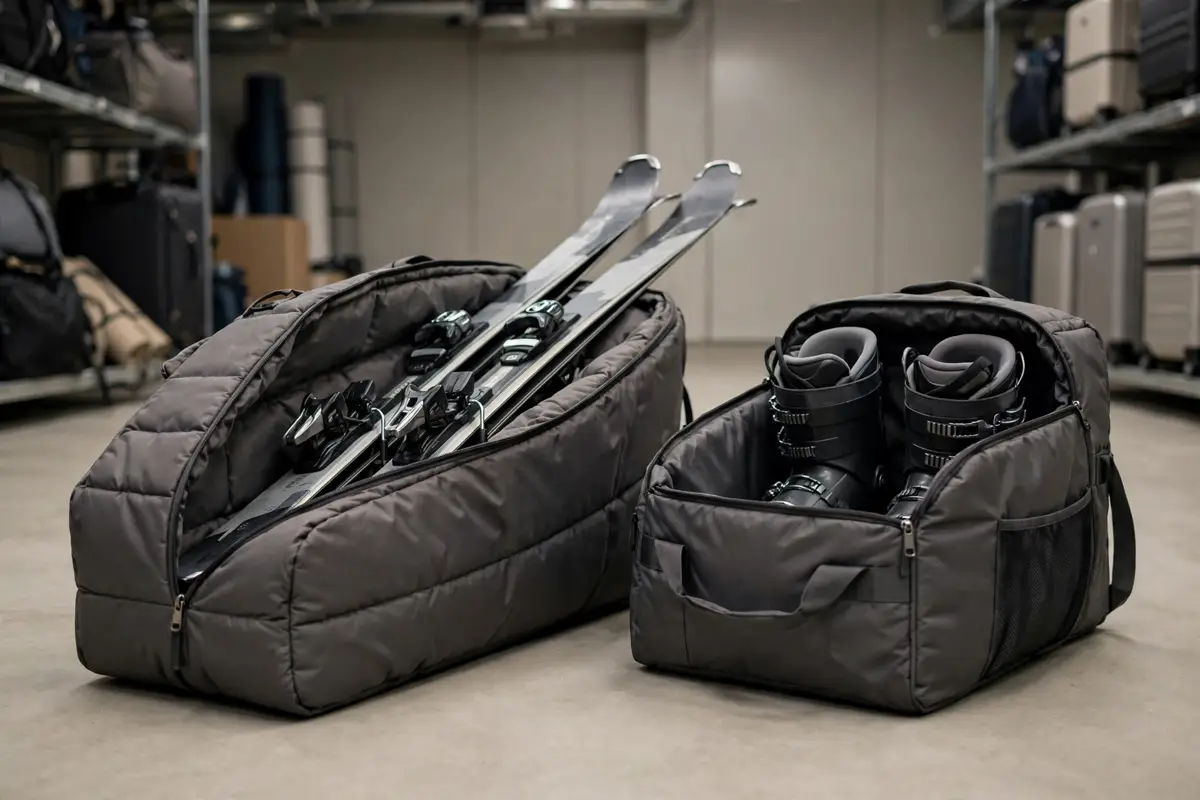
One padded ski bag (a single pair of skis + one set of poles) plus one boot bag (one pair of boots) — together counted as one checked item. Keep both clearly tagged with fully closed zippers.
Airport Check-In Process for Ski Gear
- Use the main check-in counter. Ski bags are oversized items, tagged at the ticket counter and routed to the oversize drop or belt.
- Declare it as sports equipment. Have it coded under the sports-equipment rule — one item, oversize fee waived — not as a generic oversized bag.
- Confirm the two-bag coding. If you split into a ski bag and boot bag, confirm both are tagged under the single ski-equipment item.
- Arrive with extra time. Oversize tagging adds minutes — allow at least 30 extra minutes beyond your normal arrival buffer.
- At arrival, check the oversize area. Ski bags usually come out at the oversize/bulky luggage area, not the standard carousel.
Packing Strategy for Faster Check-In
- Weigh the packed ski bag at home. Stay at or under 50 lbs to avoid the $100 overweight fee (third-party-reported).
- Put boots in the boot bag, not the ski bag. Boots add concentrated weight — separating them keeps the ski bag under the limit, and both still count as one item.
- Pad the bindings and tips. Wrap bindings in a towel and use tip protectors to prevent most transit damage.
- Never use a plastic bag as the container. Beyond the limited-release-of-liability issue, thin plastic tears on conveyors and causes repacking delays.
Category-Specific Packing Tips
Solo Skiers
Simplest case: one ski bag plus one boot bag equals one checked item. Keep heavy extras like tools and wax in your other bags to protect the 50 lb limit.
Families Traveling with Kids
Each traveler gets their own one-item allowance, so a family of four can check four ski setups. Pack each child’s short, light set as its own item and confirm the coding with the agent.
Snowboarders
One snowboard plus one pair of snowboard boots in up to two containers counts as the one item. Snowboard bags are shorter but just as heavy — the 50 lb rule applies identically.
Backcountry Riders
Skis, poles, and boots still count as the one item; beacon, shovel, and probe packed alongside are fine within the weight limit. Airbag canisters have separate hazardous-materials rules — check Southwest’s dangerous-goods guidance first.
Before You Go Checklist
- Confirm your booking date for your fee tier ($35/$45 or $45/$55).
- Weigh the packed ski bag — target 50 lbs or under.
- Pack one set only: one pair of skis or one snowboard, one set of poles, one pair of boots.
- Use a padded ski bag (not plastic) plus a boot bag — two containers max, counted as one item.
- Decide whether boots fly in the boot bag or your carry-on.
- Photograph packed gear for damage-claim documentation.
- Arrive with at least 30 extra minutes for oversize check-in.
FAQs
Do skis count as one checked bag on Southwest?
Yes. One pair of skis or one snowboard, one set of poles, and one pair of boots in up to two containers counts as one checked item (official policy) — even when the two bags are packed and tagged separately.
Can I carry skis on the plane?
No. Skis and snowboards must be checked; TSA does not allow them as carry-on. Ski boots alone may travel in your carry-on — handy for staying under the 50 lb checked-bag limit.
What if my ski bag is over 50 lbs?
Over 50 lbs triggers the overweight fee — $100 for 51–70 lbs (third-party-reported). The oversize waiver does not cover weight, so weigh at home and shift boots to your carry-on.
Does Southwest waive the oversize fee for ski bags?
Yes — waived for listed sports equipment (third-party consensus: up to 115 linear inches). Items over 100 lbs and/or 115 total inches cannot be checked (Southwest’s own pages).
How much does Southwest charge to check ski equipment in 2026?
Standard checked-bag rates by booking date: $35/$45 (booked May 28, 2025 – Apr 8, 2026) or $45/$55 (booked on/after Apr 9, 2026) — third-party-reported, current as of October 2026. No separate ski surcharge.
Related Bag Policies
- Southwest Airline Bag Policy Guide
- Southwest Airlines Carry-On Bag Policy Guide
- Frontier Bag Policy Guide
- Alaska Airlines Bag Policy Guide
Conclusion
Southwest’s ski policy is built for how skiers actually travel: skis, poles, and boots in up to two bags count as one checked item, oversize fees are waived, and there is no separate ski surcharge. The numbers to remember: 50 lbs (the overweight trigger) and your booking date ($35/$45 vs $45/$55 in 2026).
Pack a padded ski bag, weigh it at home, and declare it as sports equipment at the counter — and your gear flies as one straightforward checked item.