Pearl Harbor Bag Policy 2026 | No-Bag Rule, Clear Bags & Storage Guide
Planning a visit to Pearl Harbor and wondering what you can carry in? The pearl harbor bag policy is one of the strictest visitor rules in the National Park system. It is a no-bag policy: any bag, purse, or container that offers concealment and measures more than 1.25″ x 2.25″ x 5.5″ is not allowed inside Pearl Harbor National Memorial. Clear plastic bags whose contents are readily visible are the main exception, and paid baggage storage is available near the visitor center entrance for everything else.
This guide breaks down the official rules in plain language: what counts as a concealment bag, what clear bags are allowed, how paid storage works, and what to do about strollers, cameras, diaper supplies, and medical bags. Sort this out before you leave your hotel, because a bag problem in the parking lot is the last thing you want on a day set aside for reflection.
Quick Answer
| Question | Policy Rule |
|---|---|
| Concealment bags allowed? | No — any bag offering concealment over 1.25″ x 2.25″ x 5.5″ is prohibited |
| Small wallet or clutch limit | 1.25″ x 2.25″ x 5.5″ or smaller |
| Clear plastic bags | Allowed when contents are readily visible, similar to stadium clear bags |
| Bag storage | Yes — paid facility near the visitor center entrance, fee for all sizes including luggage |
| Strollers on shuttle boats / USS Arizona Memorial | Not permitted — strollers stay at the theater entrance porch |
| Medical bags | Allowed with screening — disclose the need to security on arrival |
| All permitted bags inspected? | Yes — all permitted bags are inspected and/or tagged as screened |
| Entry fee for the memorial grounds | None — museums and grounds are free; USS Arizona Memorial program by reservation or standby |
Official Policy Verification & Source Check
- Official source: nps.gov/perl/planyourvisit/safety.htm — Park Rules and Safety, Pearl Harbor National Memorial (U.S. National Park Service)
- Source type: Official National Park Service park page (the visitor-facing rules page the NPS itself links as its bag policy page)
- Last checked: October 25, 2026
- Confidence level: High — published on the National Park Service’s own site for this memorial
Notes on conflicting figures: There is a genuine conflict inside NPS-linked material, worth knowing about before you measure your wallet. The visitor-facing Park Rules and Safety page states the limit as 1.25″ x 2.25″ x 5.5″, and that is the figure we publish here, because it is the rule posted for visitors. However, the NPS Pearl Harbor Superintendent’s Compendium 2025 and the Pacific Historic Parks FAQ both quote the first dimension as 1.5″ x 2.25″ x 5.5″. The safe move is to measure against the stricter 1.25″ figure: a wallet that fits 1.25″ passes under either version.
How We Check This Policy: We start with the venue’s official website and read its published bag policy word for word, because security rules at a memorial on an active military installation can change without much notice. We then compare the official dimensions against Google’s AI Overview summary and partner pages. When sources disagree, the official visitor-facing figure wins, and we name the conflicting figure here.
What Makes Pearl Harbor’s Bag Policy Different
Most stadiums and arenas run a clear-bag policy: bring a clear bag up to a stated size, or a small clutch, and you are in. Pearl Harbor flips that logic. The default here is no bag at all, and the burden is on the visitor to prove their item does not conceal anything. A regular purse, handbag, backpack, fanny pack, camera bag, or diaper bag is prohibited the moment it exceeds the tiny wallet-sized limit, no matter how ordinary it looks.
The reason is the setting. Pearl Harbor National Memorial sits within Joint Base Pearl Harbor-Hickam, an active military installation. Security screening here is closer to an airport than to a ballpark gate: visitors may be scanned with a magnetometer, every permitted item is inspected, and refusal to submit to screening is grounds for refusal of entry.
The policy is also stricter than the rules at most other national parks, where a daypack is unremarkable. At Pearl Harbor, almost nothing you would normally carry a day’s supplies in will qualify. That is why the paid storage facility and the clear-bag exception matter so much: they are the two realistic ways to bring your essentials in, and planning around them is the whole visit strategy.
Allowed Bags and Size Limits
| Bag Type | Entry Status | Max Dimensions | Conditions |
|---|---|---|---|
| Concealment bag (purse, handbag, backpack, fanny pack, camera bag, diaper bag, luggage) | Not allowed | Over 1.25″ x 2.25″ x 5.5″ | Store it in the paid facility near the visitor center entrance |
| Small wallet or clutch (with or without a strap) | Allowed | 1.25″ x 2.25″ x 5.5″ or smaller | Inspected and/or tagged as screened |
| Clear plastic bag | Allowed | No stated size limit published | Contents must be readily visible, like stadium clear bags; subject to inspection |
| Small shopping bag bought in the secure zone | Allowed | Small canvas or recycled bag | Valid on the day of purchase only; not valid for re-entry after exiting the secure zone |
| Medical bag | Allowed with screening | Equipment that cannot fit in a lightweight transparent bag | Disclose the medical need to security; bag may contain medically required items only |
| Stroller with fixed pouch / wheelchair with fixed bag | Allowed on grounds | Fixed pouch or bag that cannot be removed | Inspected; strollers are not permitted on Navy shuttle boats or the USS Arizona Memorial |
Purses and Totes
Do not plan on bringing a purse or tote into Pearl Harbor. Any purse, handbag, or tote that offers concealment and exceeds 1.25″ x 2.25″ x 5.5″ is prohibited, and that covers essentially every everyday purse. A wallet or clutch at or under that limit is allowed, with or without a strap, but measure it rather than guessing: a clutch that looks small can still exceed a limit this tight.
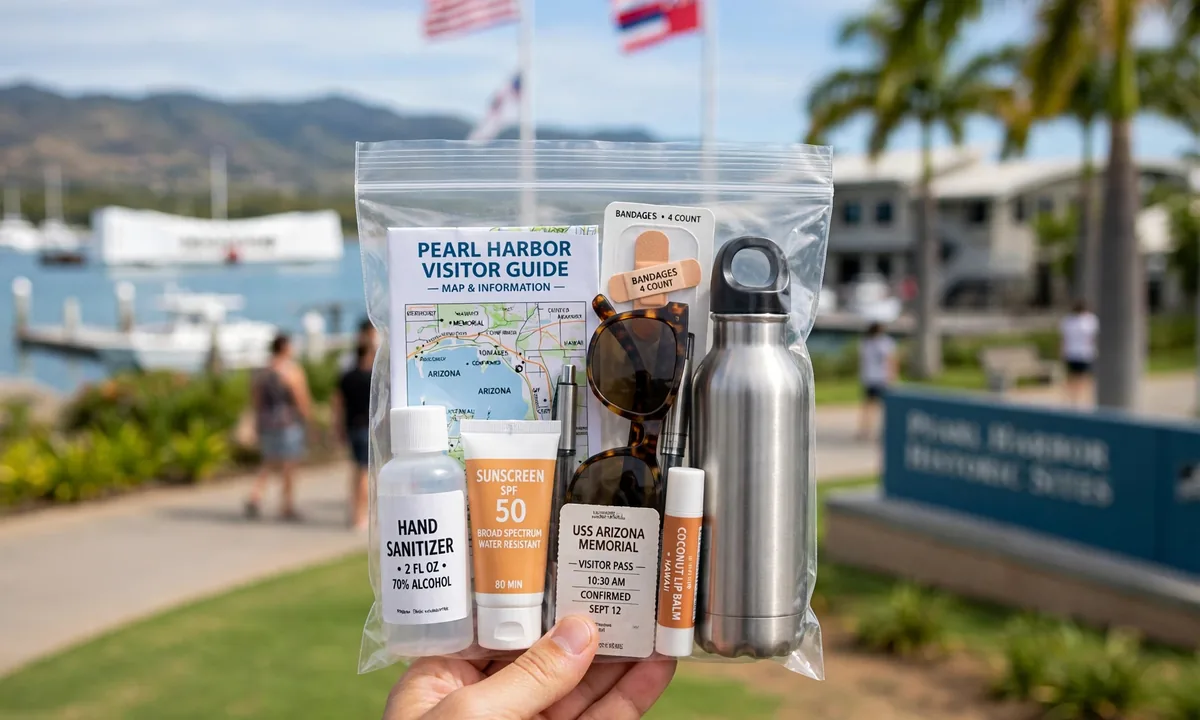
The practical replacement is a clear plastic bag. The NPS expressly allows bags in which contents are readily visible, similar to those allowed at football games, and the Pacific Historic Parks Museum Store sells clear jelly bags for this purpose. Transfer your essentials into the clear bag before you reach security, and leave the purse itself in paid storage or at your hotel.
Diaper and Medical Bags
Standard diaper bags are prohibited under the same concealment rule, so families need a different plan. Pacific Historic Parks suggests packing diapers and care items in clear sealable bags, which can ride in the stroller’s under-seat storage on the grounds. Clear bags are also sold at the museum store.
Medical bags are treated more flexibly. If you have a medical condition that requires a bag, disclose it to security on arrival. The bag is still screened, it may contain medically required items only, and the final decision rests with the Park Security Rangers, so allow extra time. Keep medication labeled and easy to reach.
What a Compliant Bag Looks Like
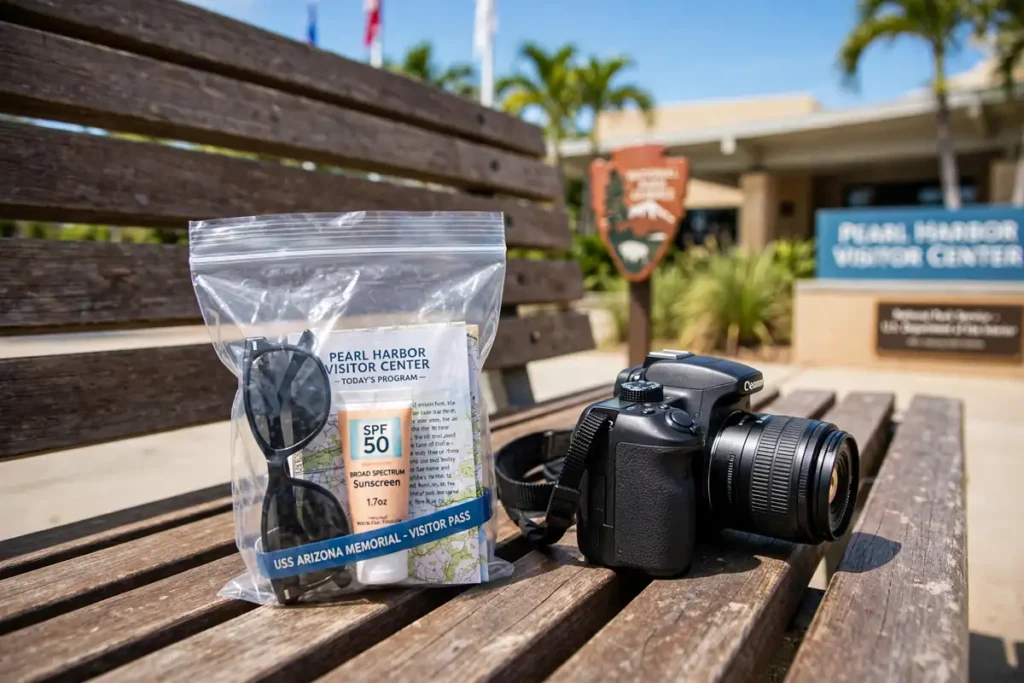
A compliant setup is deliberately simple: a clear, see-through bag holding a phone, a small wallet, keys, a camera without a case, and a water bottle. Nothing is hidden, and security can verify the contents at a glance, which is why it moves faster through the checkpoint.
Do not try to dress up a non-compliant bag as a compliant one. A clear bag stuffed inside an opaque tote or a camera bag with a clear front pocket will still be refused: if an item offers concealment, the rule applies to the item itself.
Security Screening: How Entry Actually Works
Expect a staffed security checkpoint before you enter the visitor center complex. Visitors and their permitted items are screened by NPS employees to deter and detect explosives, weapons, and other prohibited items, and visitors may be scanned with a magnetometer. Signage at the checkpoint announces the screening, and refusal to submit is grounds for refusal of entry.
All permitted bags are inspected and/or tagged as screened, so build in time for that step. Arrive early for a USS Arizona Memorial program: it runs about 45 minutes including the briefing, boat ride, and time on the memorial, and late arrivals can lose their seats to standby. There are no restrooms on the boats or the memorial, so use the visitor center facilities before boarding.
On-Site Bag Storage
The Pacific Fleet Submarine Museum operates a baggage storage facility near the entrance to the Pearl Harbor Visitor Center, to the right as you enter. There is a fee for every bag, whatever its size, including luggage. Partner listings quote $7 per bag and $10 for oversized bags or luggage, so expect to pay per item rather than per person.
One storage stop covers the whole day. The NPS notes that the same storage can be used for visits to all Pearl Harbor Historic Sites, so you do not need to re-store a bag when moving between the visitor center, the Bowfin museum, and the Ford Island sites.
Food, Beverage and Other Prohibited Items
Food and water are allowed as long as they are not concealed in a package. A visible water bottle is fine, and water is the only drink permitted inside the museums, theaters, on Navy vessels, and on the USS Arizona Memorial. Other nonalcoholic beverages are permitted on the wider site only.
Glass containers are prohibited, with two exceptions: baby food jars and tempered glass water bottles. Alcohol is not allowed anywhere on the premises. Aerosol containers are also prohibited, so apply sunscreen before arrival or carry a non-aerosol lotion in your clear bag. Smoking is not allowed on the grounds or at the memorial.
Prohibited Items
- Bags, packages, or containers offering concealment that exceed 1.25″ x 2.25″ x 5.5″ (purses, handbags, backpacks, fanny packs, camera bags, diaper bags, luggage)
- Weapons of any kind, including knives, multitools, pocket knives, sabers, bayonets, swords, daggers, and machetes
- Guns or items that shoot projectiles, including toys, tasers, and stun guns
- Chemical or biological agents, including mace, pepper spray, or other propellants
- Explosives, explosive devices, or components of an explosive device or system
- Glass containers, except baby food jars and tempered glass water bottles
- Aerosol containers of any kind
- Alcoholic beverages
- Musical instruments and cases, unless related to an NPS-issued Special Use Permit
- Recreational equipment, including skateboards, skate shoes, Frisbees, and balls
- Bicycles, scooters, e-bikes, Segways, or other rideable devices
- Flowers in pots, vases, or containers; potted plants; balloons
- Flags, signs, or banners on posts or poles, and wreaths on stands, unless related to a permit
Packing Strategy for Faster Entry
Start with a clear bag, not a purse. Transfer your phone, ID, wallet, keys, and camera into a clear bag at the hotel, and you will walk through screening without the conversation an opaque bag always triggers.
Measure the wallet, do not eyeball it. The limit is 1.25″ x 2.25″ x 5.5″, which is smaller than most card wallets once they are full. If it is over, it goes in the clear bag or into storage, not into a pocket in the hope that nobody notices.
Wear your sun protection. Apply non-aerosol sunscreen and bring a hat before you arrive, since aerosol cans are prohibited and shade on the grounds is limited. Wear comfortable walking shoes: the walk between facilities is longer than most visitors expect.
Carry the camera without the case. Small cameras and camcorders are permitted, but a camera bag is a concealment bag and will be refused. Carry the camera in hand or in the clear bag, and leave the case in storage.
Arrive an hour before your program. That buffer covers parking, the storage stop if you need one, screening, and check-in, with time to use the restrooms before the 45-minute boat program.
Category-Specific Packing Tips
Families with babies and toddlers: Pack diapers, wipes, and a change of clothes in clear sealable bags and use the stroller’s under-seat storage on the grounds. Bring a baby carrier for the boat program, because strollers are not permitted on Navy shuttle boats or the USS Arizona Memorial. Strollers are left at the memorial theater’s front entrance porch for the program’s duration.
Visitors with medical needs: Disclose the medical bag to security immediately on arrival and keep it limited to medically required items. Allow extra time for screening, keep medication labeled and accessible, and remember that the final decision rests with the Park Security Rangers.
Photographers: Bring the camera body and a lens you can carry in hand or in a clear bag, and leave the camera bag, tripod case, and accessory pouches in storage. Be ready for every item to be inspected before you board.
Visitors with mobility needs: Wheelchairs with fixed bags that cannot be removed are permitted throughout the visitor center, theaters, and memorial. The park is ADA compliant and benches are placed throughout the grounds, but the visitor center does not provide wheelchairs except in emergencies, so bring your own if you need one.
Before You Go Checklist
- ☐ Clear plastic bag packed with phone, wallet, keys, camera, and water
- ☐ Wallet or clutch measured at 1.25″ x 2.25″ x 5.5″ or smaller — or left in storage
- ☐ Purse, backpack, camera bag, and diaper bag left at the hotel or headed for paid storage
- ☐ Non-aerosol sunscreen applied; hat and comfortable walking shoes on
- ☐ Medical bag disclosed to security on arrival, medication labeled and accessible
- ☐ Baby carrier packed if traveling with a small child (strollers stay at the theater porch)
- ☐ USS Arizona Memorial reservation or standby plan confirmed; arrival at least one hour early
- ☐ Restrooms used at the visitor center before boarding (none on boats or the memorial)
- ☐ Nothing valuable left visible in the parked vehicle
- ☐ Official NPS safety page rechecked on the morning of the visit
FAQs
Can I bring a purse into Pearl Harbor?
No, not a normal one. Any purse, handbag, or bag that offers concealment and exceeds 1.25″ x 2.25″ x 5.5″ is prohibited. A wallet or clutch at or under that size is allowed, and a clear plastic bag is the practical alternative.
Are clear stadium bags allowed at Pearl Harbor?
Yes. The NPS expressly allows clear plastic bags in which contents are readily visible, similar to those allowed at football games. Clear jelly bags are also sold at the museum store. The bag and its contents are still inspected.
Where do I store my bag at Pearl Harbor, and what does it cost?
The Pacific Fleet Submarine Museum runs a baggage storage facility near the visitor center entrance, to the right as you enter. There is a fee for all sizes, including luggage, and partner listings quote $7 per bag and $10 for oversized bags or luggage.
Can I take a stroller on the USS Arizona Memorial boat?
No. Strollers are allowed on the grounds and in the pre-boarding area, but not on Navy shuttle boats or the USS Arizona Memorial. Strollers and wheelchairs may be left at the memorial theater’s front entrance porch for the program, so bring a carrier for small children.
What if I need a medical bag?
Disclose the medical need to security on arrival. Medical bags containing equipment that cannot be placed in a lightweight transparent bag are permitted, but they are screened, they may contain medically required items only, and the final decision rests with the Park Security Rangers.
Related Bag Policies
- Hawaiian Airlines Bag Policy Guide
- Disneyland Bag Policy Guide
- Georgia Aquarium Bag Policy Guide
- Universal Studios Bag Policy Guide
Conclusion
Pearl Harbor’s bag policy is strict, but it is not complicated once you accept its starting point: no concealment bags, period, unless they are wallet-sized or see-through. Pack a clear bag, measure anything opaque against the 1.25″ x 2.25″ x 5.5″ limit, and use the paid storage facility near the entrance for everything else.
With the bag question settled, arrive early, allow time for the film and the boat program, carry water for the outdoor grounds, and keep the focus where it belongs: on the history, the people, and the quiet of the memorial itself. Recheck the official NPS safety page on the morning of your visit, because security rules here are worth verifying twice.